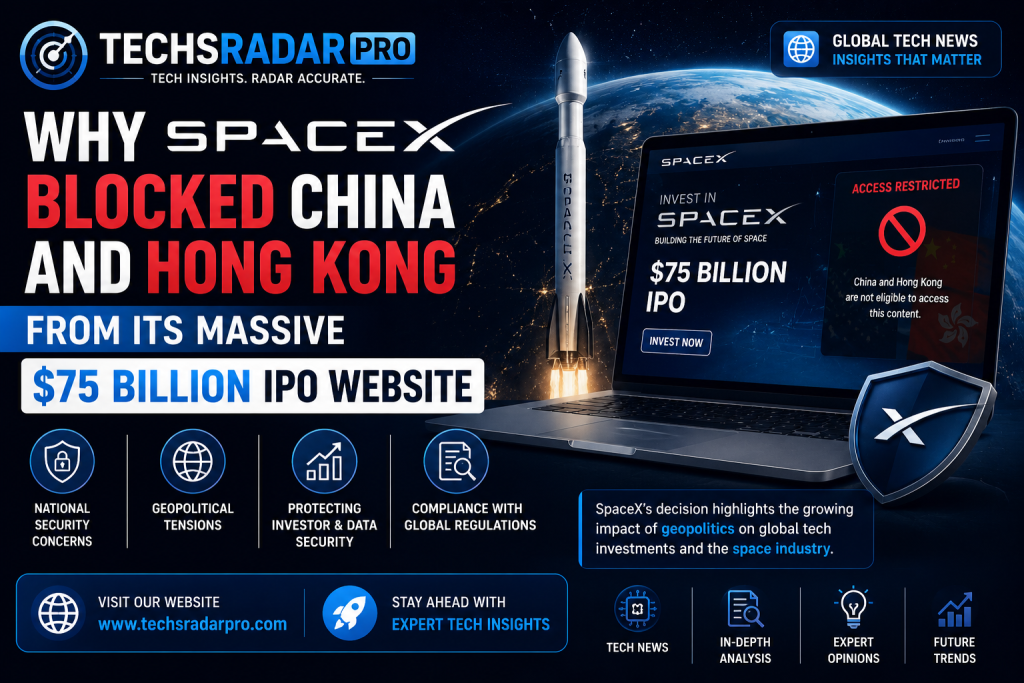
Why SpaceX Blocked China and Hong Kong From Its Massive $75 Billion IPO Website
The tech and financial worlds are buzzing with excitement over Elon Musk’s SpaceX finally kicking off its highly anticipated Initial Public Offering (IPO) roadshows. Aiming to raise a historic $75 billion at a staggering $1.75 trillion valuation, this is on track to become the largest stock market debut in U.S. history. However, amidst the global excitement, a massive digital wall has suddenly gone up. Investors and tech enthusiasts trying to access the SpaceX website or view the official IPO marketing documents from mainland China and Hong Kong are currently being greeted by a dead end. The restriction has raised serious questions about global investing, geopolitics, and digital borders. Here is a breakdown of what is happening, why it matters, and the hidden reasons behind the block. The Digital Dead End: Inside “Error 1009” When users across major Asian markets—such as Singapore, Japan, and Pakistan—click on the newly released SpaceX S-1 filing and marketing materials, the pages load instantly. But for users attempting to log on from Hong Kong or mainland China, the site returns a generic “Error 1009” screen. According to web security provider Cloudflare, an Error 1009 explicitly means that the website owner has deliberately banned or geofenced the specific country or region’s IP address range from accessing the server.In short: This isn’t China’s Great Firewall blocking SpaceX. It is SpaceX actively blocking China and Hong Kong. Why Would SpaceX Geofence Hong Kong and China? While SpaceX has not officially commented on the block outside of U.S. working hours, financial analysts and cybersecurity experts point to three primary reasons for this sudden lockdown: 1. Intense U.S. Regulatory & National Security Pressure SpaceX isn’t just a commercial tech company; it is a critical U.S. defense contractor. With its Falcon rockets, Starshield military network, and deep ties to NASA and the Pentagon, SpaceX’s intellectual property is highly classified. Just a few months ago, U.S. senators publicly pushed the Pentagon to audit SpaceX over concerns that foreign investors—specifically from China—were quietly trying to buy stakes in the private firm through secondary markets. By blocking the region entirely from the official IPO materials, SpaceX is likely attempting to shield itself from regulatory scrutiny regarding foreign capital. 2. Standard U.S. Securities Compliance (Regulation S) When a U.S. company goes public, strict SEC rules dictate who can be marketed to. Hong Kong has historically been a massive hub for global wealth, but marketing a highly sensitive, defense-adjacent U.S. tech company directly to retail or institutional investors in Chinese jurisdictions can create legal regulatory nightmares under U.S. securities laws. 3. The Shift in Hong Kong’s Legal Status Francis Fong, the honorary president of the Hong Kong Information Technology Federation, noted that while Hong Kong users have occasionally faced blocks on U.S. government websites in recent years, it remains incredibly rare for a major commercial enterprise to block the global financial hub. This move signals a growing caution among American tech giants, who now view Hong Kong’s digital space through the same geopolitical lens as mainland China. What Does This Mean for Global Investors? The geofence is a heavy blow for investors based in Hong Kong who were eager to get an early piece of the world’s most valuable aerospace corporation. Institutional and retail investors rely on these roadshow documents to analyze revenues, like Starlink’s impressive $4.4 billion operating income from last year, against SpaceX’s heavy R&D losses. Without direct access to the source material on SpaceX’s portal, regional investors will have to rely on third-party financial platforms, global brokerage networks, or international exchange-traded funds (ETFs) to gain indirect exposure to Musk’s space empire once it officially lists around mid-June. The Bottom Line Elon Musk is undeniably a household name in China, largely thanks to the massive success and local manufacturing of Tesla. However, when it comes to rockets, satellites, and next-generation defense tech, business ties take a backseat to national security. SpaceX’s choice to pull the digital shutter on Hong Kong and China proves that as tech companies scale into trillion-dollar giants, they cannot escape the gravity of global politics.